
Mindfulness
Relaxation Techniques, Coping Skills, & Journaling
“Everything is created twice. First in the mind and then in reality.”
– Robin Sharma
MINDFULNESS is the basic human ability to be fully present, aware of where we are and what we’re doing, and not overly reactive or overwhelmed by what’s going on around us. Mindfulness is a quality that every human being already possesses. Way to approach everyday life that makes living more enjoyable and less stressful.

“Mindfulness gives you time. Time gives you choices. Choices, skillfully made, lead to freedom.”
– Bhante Henepola Gunaratana
Mindfulness is:
- A choice YOU can make
- Being aware of how you feel and what you are experiencing
- Being in the present moment
- Choosing to be nice to yourself and others
- Approaching life with curiosity and kindness instead of judgement and criticism
- Bringing an open awareness of the present moment
- Paying attention with purpose
- Focusing on the here and now
- Training your mind to level up with kindness
- Engaging in everyday life
- Actively listening with the goal of understanding
- Pausing your reactions and responses
- Practicing paying attention to yourself and others with kindness and appreciation.

Belly Breathing
Learn how to complete a belly breathing exercise that can be done anywhere at any time.
Everyday Mindfulness
This video explains what everyday mindfulness is, and how being aware of what is going on around you and inside…
Practice Mindfulness with Belly Breathing
Diaphragmatic breathing, also known as belly breathing, is a calming exercise that both children and parents can practice to relax…Breathing Exercises for Children
When we take deep breaths, we send a message back to the brain: It’s okay to settle down.Take a Deep Breath and Count to Four
Dealing with angry feelings: When you feel so mad that you want to roar, take a deep breath and count…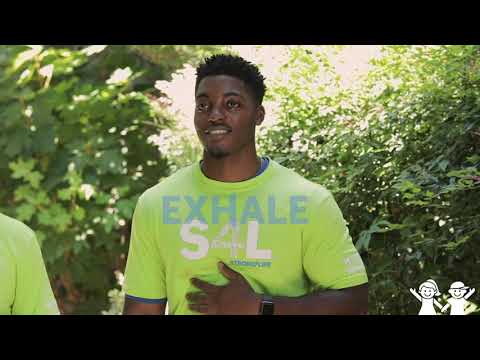
Deep Breathing: Middle and High School
Take a quick brain break with the Strong4Life Challenge Team. Deep breathing is a coping strategy that can be used…
References:
Brading, T. (2020, September 30). Holistic health added to Army Fitness doctrine. U.S. Army. https://www.army.mil
Cozza, S. J., Knobloch, L. K., Gewirtz, A. H., DeVoe, E. R., Gorman, L. A., Flake, E. M., … & Lerner, R. M. (2018). Lessons learned and future recommendations for conducting research with military children and families. In Hughes- Kirchubel, L., Wadsworth, S., Riggs, D. (eds.), A battle plan for supporting military families (pp. 265-287). Springer, Cham. https://10.1007/978-3-319-68984-5
Doran. (n.d.). There’s a S.M.A.R.T. way to write management’s goals and objectives. Management Review, 70(11), 35–36. https://doi.org/info:doi/
Drigas, A. S., & Papoutsi, C. (2018). A new layered model on emotional intelligence. Behavioral Sciences (Basel, Switzerland), 8(5), 45. https://doi.org/10.3390/bs8050045
Goleman D.P. (1995). Emotional intelligence: Why it can matter more than IQ for character, health and lifelong achievement. Bantam Books.
Gribble, R., Mahar, A. L., Keeling, M., Sullivan, K., McKeown, S., Burchill, S., … & Castro, C. A. (2020). Are we family? A scoping review of how military families are defined in mental health and substance use research. Journal of Military, Veteran and Family Health, 6(2), 85-119. https://doi.org/10.3138/jmvfh-2019-0054
Hughes-Kirchubel, L., Wadsworth, S.M. (2018). Introduction to a battle plan for supporting military families. In Hughes- Kirchubel, L., Wadsworth, S., Riggs, D. (eds.), A battle plan for supporting military families (pp. 1-10). Springer, Cham. https://doi.org/10.1007/978-3-319-68984-5_1
Klug, H. J. P., & Maier, G. W. (2015). Linking goal progress and subjective well-being: A meta-analysis. Journal of Happiness Studies: An Interdisciplinary Forum on Subjective Well-Being, 16(1), 37-65. https://doi.org/10.1007/s10902-013-9493-0
Masten, A. S. (2018). Resilience theory and research on children and families: Past, present, and promise. Journal of Family Theory & Review, 10(1), 12-31. https://doi.org/10.1111/jftr.12255
Masten, A. S. (2021). MULTISYSTEM RESILIENCE: PATHWAYS TO AN INTEGRATED FRAMEWORK. Research in Human Development, 18(3), 153-163. https://doi.org/10.1080/15427609.2021.1958604 .
Maybery, D. J., Goodyear, M. J., Reupert, A. E., & Harkness, M. K. (2013). Goal setting within family care planning: families with complex needs. The Medical journal of Australia, 199(3), S37–S39. https://doi.org/10.5694/mja11.11179
Mullet, N., Fuss, C., Lyddon, L., Mondloch, D., Neal, S., Nelson Goff, B. S., … & Ruhlmann, L. M. (2021). Finding our new normal: A 10-year follow-up study with US Army veterans and their spouses. Journal of Couple & Relationship Therapy, 1-25. https://doi.org/10.1080/15332691.2021.1945986
Office of the Surgeon General (OSG). (2021). Protecting youth mental health: The U.S. Surgeon General’s Advisory. US Department of Health and Human Services. https://www.ncbi.nlm.nih.gov/books/NBK575984/
Pexton, S., Farrants, J., & Yule, W. (2018). The impact of fathers’ military deployment on child adjustment. The support needs of primary school children and their families separated during active military service: A pilot study. Clinical Child Psychology and Psychiatry, 23(1), 110–124. https://doi.org/10.1177/1359104517724494
Siegel, D. J., & Bryson, P. H. D. T. P. (2012). The whole-brain child. Random House. https://dx.doi.org/10.1111/camh.12053_6
Sigelman, C. K., Friedman, S. L., & Kildon, J. (2019). Communication, context, and well-being among military couples. Military Behavioral Health, 7(4), 363-375. https://doi.org/10.1080/21635781.2019.1646173
Sullivan, R. M., Cozza, S. J., & Dougherty, J. G. (2019). Children of military families. Child and adolescent psychiatric clinics of North America, 28(3), 337–348. https://doi.org/10.1016/j.chc.2019.02.004
Theiss, J. A. (2018). Family communication and resilience. Journal of Applied Communication Research, 46(1), 10-13. https://doi.org/10.1080/00909882.2018.1426706
Disclosure Statement: These tools are not intended to be a substitute for professional medical advice, diagnosis, or treatment. Always seek the advice of your physician or other qualified health providers with any questions you may have regarding a medical condition. Never disregard professional medical advice or delay in seeking it because of something you have read on this website.

Have a Question? Ask an MSC!
If you have a question about academic transition, education options, or how to best meet the needs of your military-connected child, connect with a Military Student Consultant.
Our MSCs truly understand the challenges related to military life and they stand ready to serve.