
Self-Management
“Anybody can become angry – that is easy, but to be angry with the right person and to the right degree and at the right time and for the right purpose, and in the right way – that is not within everybody’s power and is not easy.”
– Aristotle
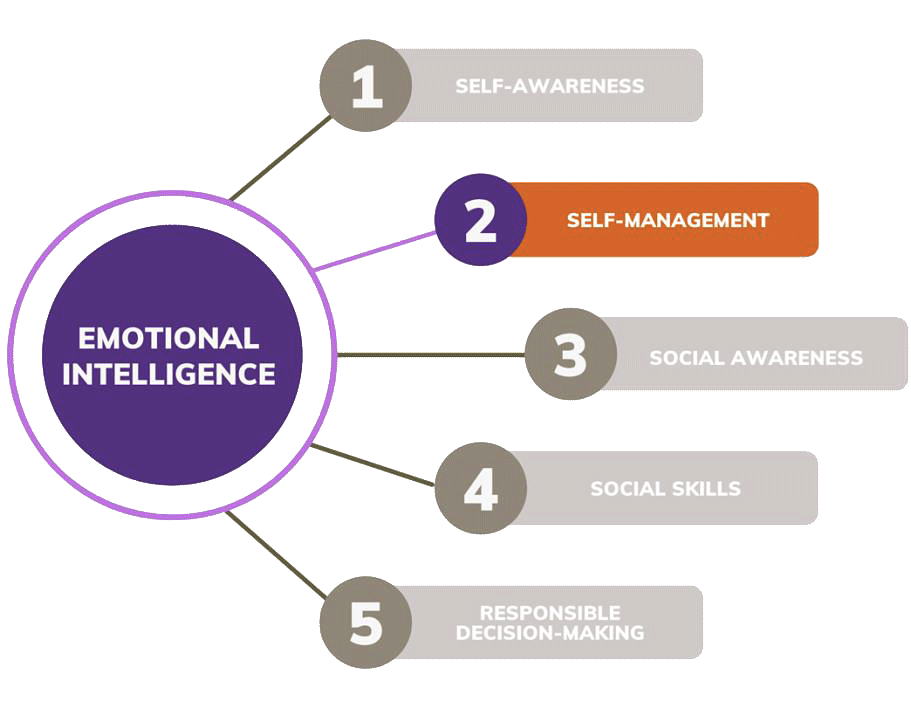
SELF-MANAGEMENT: The ability to manage one’s emotions, thoughts, and behaviors effectively in different situations and to achieve goals and aspirations.
Self-management means having a strategy and techniques to deal with a range of strong feelings or emotions in the moment (positive or negative). When military students are self-aware, they are prepared to regulate and control their emotions, delay gratification, minimize impulses, manage stress, and motivate themselves toward personal and academic goals. Self-management requires students to be proactive and to think about their response to strong feelings or emotions. Military children will grow in emotional intelligence as parents, teachers, and other youth-serving professionals model and teach these self-management skills:
- Managing one’s emotions
- Identifying and using stress management strategies
- Exhibiting self-discipline and self-motivation
- Setting personal and collective goals
- Using planning and organizational skills
- Showing the courage to take initiative
- Demonstrating personal and collective agency
Feelings Color Zones
Labeling feelings is part of proven strategies that increase emotional regulation. “If you can name it, you can tame it!”Your BEST Communication Skills
Using your BEST communication skills means using assertive body language, eye contact, speech, and tone of voice.Emotion Wheel
A study by The Greater Good Science Center suggests there are 27 distinct emotions. With so many emotions, how can…Handling Tantrums
Tantrums are tough for kids and parents, but there are ways to deal with them to help everyone cope with…Seeing, Showing, Sharing Emotions
Help your children express themselves with a strong feelings vocabulary.Group Leader EQ Survey
As you prepare to lead lessons on emotional intelligence, it helps to consider your own strengths and challenges when it…
Integrated Learning, Integrated Lives
Highlighting Opportunities for Transformative SEL Within Academic InstructionStudent Mental Health and Well-being
A review of evidence and emerging solutions, by CRPE Reinventing Public EducationEducator Well-Being as a Pathway Toward Investing in Education Staff
Insights from the Transformative SEL (tSEL) Adult Learning Series PilotGuidance on Supporting Classroom SEL
Schoolwide SEL helps students excel academically, build stronger relationships, and lead happier, healthier, more fulfilling lives.References:
Brading, T. (2020, September 30). Holistic health added to Army Fitness doctrine. U.S. Army. https://www.army.mil
Cozza, S. J., Knobloch, L. K., Gewirtz, A. H., DeVoe, E. R., Gorman, L. A., Flake, E. M., … & Lerner, R. M. (2018). Lessons learned and future recommendations for conducting research with military children and families. In Hughes- Kirchubel, L., Wadsworth, S., Riggs, D. (eds.), A battle plan for supporting military families (pp. 265-287). Springer, Cham. https://10.1007/978-3-319-68984-5
Doran. (n.d.). There’s a S.M.A.R.T. way to write management’s goals and objectives. Management Review, 70(11), 35–36. https://doi.org/info:doi/
Drigas, A. S., & Papoutsi, C. (2018). A new layered model on emotional intelligence. Behavioral Sciences (Basel, Switzerland), 8(5), 45. https://doi.org/10.3390/bs8050045
Goleman D.P. (1995). Emotional intelligence: Why it can matter more than IQ for character, health and lifelong achievement. Bantam Books.
Gribble, R., Mahar, A. L., Keeling, M., Sullivan, K., McKeown, S., Burchill, S., … & Castro, C. A. (2020). Are we family? A scoping review of how military families are defined in mental health and substance use research. Journal of Military, Veteran and Family Health, 6(2), 85-119. https://doi.org/10.3138/jmvfh-2019-0054
Hughes-Kirchubel, L., Wadsworth, S.M. (2018). Introduction to a battle plan for supporting military families. In Hughes- Kirchubel, L., Wadsworth, S., Riggs, D. (eds.), A battle plan for supporting military families (pp. 1-10). Springer, Cham. https://doi.org/10.1007/978-3-319-68984-5_1
Klug, H. J. P., & Maier, G. W. (2015). Linking goal progress and subjective well-being: A meta-analysis. Journal of Happiness Studies: An Interdisciplinary Forum on Subjective Well-Being, 16(1), 37-65. https://doi.org/10.1007/s10902-013-9493-0
Masten, A. S. (2018). Resilience theory and research on children and families: Past, present, and promise. Journal of Family Theory & Review, 10(1), 12-31. https://doi.org/10.1111/jftr.12255
Masten, A. S. (2021). MULTISYSTEM RESILIENCE: PATHWAYS TO AN INTEGRATED FRAMEWORK. Research in Human Development, 18(3), 153-163. https://doi.org/10.1080/15427609.2021.1958604 .
Maybery, D. J., Goodyear, M. J., Reupert, A. E., & Harkness, M. K. (2013). Goal setting within family care planning: families with complex needs. The Medical journal of Australia, 199(3), S37–S39. https://doi.org/10.5694/mja11.11179
Mullet, N., Fuss, C., Lyddon, L., Mondloch, D., Neal, S., Nelson Goff, B. S., … & Ruhlmann, L. M. (2021). Finding our new normal: A 10-year follow-up study with US Army veterans and their spouses. Journal of Couple & Relationship Therapy, 1-25. https://doi.org/10.1080/15332691.2021.1945986
Office of the Surgeon General (OSG). (2021). Protecting youth mental health: The U.S. Surgeon General’s Advisory. US Department of Health and Human Services. https://www.ncbi.nlm.nih.gov/books/NBK575984/
Pexton, S., Farrants, J., & Yule, W. (2018). The impact of fathers’ military deployment on child adjustment. The support needs of primary school children and their families separated during active military service: A pilot study. Clinical Child Psychology and Psychiatry, 23(1), 110–124. https://doi.org/10.1177/1359104517724494
Siegel, D. J., & Bryson, P. H. D. T. P. (2012). The whole-brain child. Random House. https://dx.doi.org/10.1111/camh.12053_6
Sigelman, C. K., Friedman, S. L., & Kildon, J. (2019). Communication, context, and well-being among military couples. Military Behavioral Health, 7(4), 363-375. https://doi.org/10.1080/21635781.2019.1646173
Sullivan, R. M., Cozza, S. J., & Dougherty, J. G. (2019). Children of military families. Child and adolescent psychiatric clinics of North America, 28(3), 337–348. https://doi.org/10.1016/j.chc.2019.02.004
Theiss, J. A. (2018). Family communication and resilience. Journal of Applied Communication Research, 46(1), 10-13. https://doi.org/10.1080/00909882.2018.1426706
Disclosure Statement: These tools are not intended to be a substitute for professional medical advice, diagnosis, or treatment. Always seek the advice of your physician or other qualified health providers with any questions you may have regarding a medical condition. Never disregard professional medical advice or delay in seeking it because of something you have read on this website.

Have a Question? Ask an MSC!
If you have a question about academic transition, education options, or how to best meet the needs of your military-connected child, connect with a Military Student Consultant.
Our MSCs truly understand the challenges related to military life and they stand ready to serve.